
The transition toward low-carbon energy systems has accelerated the development of hydrogen-based solutions across multiple industries. Within this context, advances in fuel cell technology are playing a central role in both research and real-world applications. For engineering faculties, gaining a solid understanding of these systems is no longer optional — it is essential for addressing current challenges in thermodynamics, electrochemistry, and sustainable energy integration.
As universities adapt their curricula to align with the demands of Industry 4.0 and the growing hydrogen economy, the need for a structured and technical perspective on fuel cells becomes increasingly important.
The Electrochemical Foundation: How Fuel Cells Operate
At their core, fuel cells are electrochemical devices that convert the chemical energy of a fuel—most commonly hydrogen—and an oxidizing agent, typically oxygen, directly into electricity. Unlike conventional combustion-based systems, which are limited by thermal efficiency constraints, fuel cells rely on electrochemical reactions, allowing for higher efficiency and lower emissions.
The process is based on three primary components: the anode, the cathode, and the electrolyte. In Proton Exchange Membrane (PEM) systems, one of the most widely studied configurations, the operation can be summarized as follows:
- Anodic Reaction: Hydrogen molecules (H₂) are supplied to the anode, where a catalyst facilitates their separation into protons (H⁺) and electrons (e⁻).
- Proton Transfer: The electrolyte membrane selectively allows protons to pass through to the cathode while preventing electrons from following the same path.
- Electrical Generation: Electrons are forced through an external circuit, generating a continuous electric current.
- Cathodic Reaction: At the cathode, protons, electrons, and oxygen (O₂) combine to form water (H₂O) and release heat as a byproduct.
This direct conversion process is what enables fuel cells to achieve electrical efficiencies that can exceed 60%, with even higher performance in combined heat and power (CHP) systems.
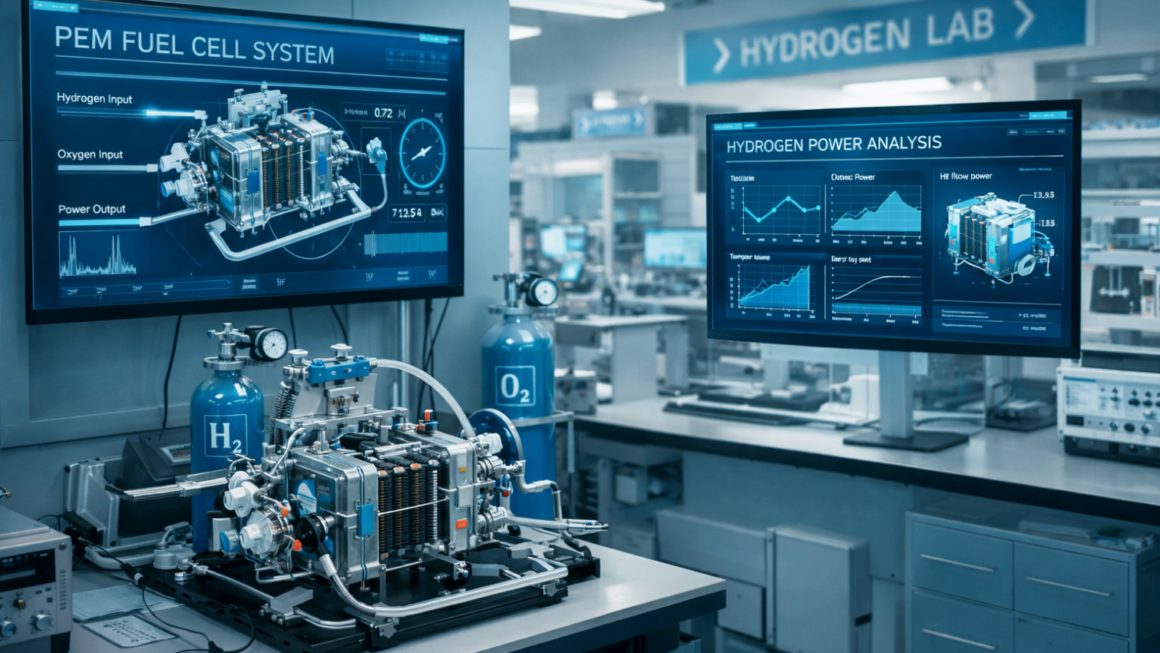
For practical and educational purposes, laboratory-scale systems such as this computer-controlled PEM fuel cell unit allow students and researchers to observe these processes in real time, bridging the gap between theory and application.
Classification of Fuel Cell Technologies
Fuel cells can be categorized according to the type of electrolyte used, which directly influences their operating temperature, efficiency, and potential applications.
Proton Exchange Membrane Fuel Cells (PEMFC)
Operating at relatively low temperatures (50°C to 100°C), PEM fuel cells are known for their high power density and fast startup times. These characteristics make them particularly suitable for transportation and portable applications. In research and academic environments, they are frequently used to study dynamic performance and system efficiency under varying conditions.
Solid Oxide Fuel Cells (SOFC)
SOFC systems use a solid ceramic electrolyte and operate at much higher temperatures, typically between 500°C and 1,000°C. This allows them to achieve high efficiencies and makes them well-suited for stationary energy generation and combined heat and power applications. Additionally, their ability to internally reform fuels such as natural gas adds flexibility, although it also introduces material and durability challenges.
Alkaline Fuel Cells (AFC)
Alkaline fuel cells utilize an aqueous solution of potassium hydroxide as the electrolyte. Historically used in aerospace applications, they offer high efficiency but are sensitive to carbon dioxide contamination. This limitation has restricted their broader commercial adoption despite their strong performance in controlled environments.
Applications Across Key Sectors
The adaptability of fuel cell systems has enabled their deployment across a wide range of sectors, contributing to ongoing efforts toward decarbonization.
In the mobility sector, fuel cell electric vehicles (FCEVs) are gaining traction, particularly in heavy-duty transport, maritime operations, and rail systems, where long range and fast refueling are critical advantages.
In industrial settings, high-temperature fuel cells provide both electrical and thermal energy, supporting energy-intensive processes while reducing emissions. Their integration into industrial infrastructure is becoming increasingly relevant as companies pursue sustainability targets.
For stationary power generation, fuel cells offer reliable baseload energy for critical facilities such as hospitals and data centers, where uninterrupted power supply is essential.
Integrating Fuel Cell Systems into Engineering Education
As the demand for hydrogen-based technologies grows, engineering education must evolve to include both theoretical and practical training. Understanding system behavior, efficiency variables, and real-world constraints is crucial for preparing future engineers.
Advanced laboratory equipment plays a key role in this process. Solutions developed by specialized manufacturers enable students to analyze performance parameters such as polarization curves, efficiency losses, and the effects of temperature and pressure on system output. More advanced setups, such as this computer-controlled PEM fuel cell advanced unit, further expand experimentation capabilities by allowing deeper analysis of system behavior under controlled conditions.
These tools bridge the gap between theoretical knowledge and hands-on experience, providing a deeper understanding of how fuel cell systems operate in real-world scenarios.
Fuel cell systems are becoming an integral component of the global energy landscape, offering a viable pathway toward cleaner and more efficient power generation. Their relevance spans from academic research to large-scale industrial applications, making them a critical area of study within modern engineering disciplines.
For educational institutions, combining solid theoretical foundations with practical experimentation will be essential to equip the next generation of engineers with the skills needed to drive innovation in this rapidly evolving field.